In
the same way that comic readers of the 1970s were familiar with the
big names in comic publishing (IPC, DC Thomson, Marvel, DC), so were the
consumers of sweets (very often overlapping in the Venn diagram of
newsagent patrons) aware of the manufacturers of their favourite
treats. Rowntrees, Trebor, Mackintosh, Cadbury, Mars – mention of
these names would bring on a craving for something sweet and either
chewy, crunchy, chocolatey, minty or else fruity and boiled (or
possibly, in the case of those with generous pocket-money allowances,
a combination of all the above).
There
was yet another titan of the enamel-eroders; Bassett's. Bassett's
were probably most associated with their iconic Jelly Babies and
Liquorice Allsorts, but the company's ads in Cheeky Weekly focused on a range
of pre-packaged confectionery clearly aimed at the younger end of the
sweet-buying market. Running during the latter half of 1978 for a
total of 5 times, the adverts (all identical) alerted readers to a
promotion whereby 12 empty bags from the range could be exchanged for
a book featuring Paddington Bear. The marmalade-loving ursine
immigrant had been appearing in children's books since 1958, but in
1975 he made the leap to the small screen in a high-profile animated
series, and Bassett's no doubt hoped to capitalise on the resurgent
interest in the character. It seems those who survived the sugary
onslaught necessary to accumulate the requisite 12 depleted packs
were able to specify which Paddington book they required from a
selection of 8. 11 tomes relating the misadventures of the furry,
hat-sporting Peruvian had been published by this time, but maybe the
books on offer were specially produced for the purposes of the
promotion – despite an exhaustive search of the internet (lasting
almost 3 minutes) I've been unable to source any further information
regarding this ad campaign, so we'll probably never know.
Advertiser Bassett's
Issue Date
Page
Page Type
Advertiser
Subject
22-Jul-1978
22
Normal
Bassett's
05-Aug-1978
9
Normal
Bassett's
09-Sep-1978
13
Normal
Bassett's
14-Oct-1978
11
Normal
Bassett's
18-Nov-1978
8
Normal
Bassett's
Similarly-named
sweet manufacturer Barratt ran a short promotion in September 1979
relating to their Oran-gee-tang nougat bar. Were you one of those
kids who pronounced it 'nugget', or did you use the posher-sounding
'noogah'. I must confess I fell into the latter category. Like
Basset's, Barratt chose to anthropomorphise their campaign, but in
this case it was an unknown primate of their own devising, looking
more like a gorilla than the orangutan it was presumably supposed to
resemble, who was chosen to head up the promotion. Unlike Bassett's,
Barratt chose to place full-page, colour ads, although the Barratt campaign
was much shorter.
Barratt
required of their respondents less exposure to tooth-rotting
materials than their rival, as just two wrappers from the
rainforest-inhabitant-referencing, filling-loosening comestible would
facilitate entry into a competition to win a 'customised' bike. Again
the ad is somewhat lacking in detail, giving no indication as to the
nature of said customisations. Possibly a giant, flashing fibreglass
Oran-gee-tang bar attached to the handlebars – once more the
internet fails to furnish enlightenment.
The
shops of retailer John Menzies were, in terms of stock, very similar
to those of WH Smith. Books, magazines, comics, records and stationery filled
the shelves in outlets of both companies. WH Smith placed 11 adverts in the pages of Cheeky Weekly, only one of which featured in two issues. John
Menzies placed two ads in the toothy funster's comic, both of which
were the same.
The above
ad appeared in the run-up to Christmas 1978 (issues dated 18 and 25
November), and a glance at the banner would suggest Menzies were
promoting toys linked to the Star Wars phenomenon which had developed
since the first film made its UK debut a year earlier. However, there's not a Vader, Skywalker or droid to be seen - the
ad promotes a selection of boxed games. Pursuits of this type would be usurped by the silicon-chipped gadgetry proliferating in homes across the country before too long.
The highly inflationary economy of the late 70s meant that retailers often included small print intimating that prospective purchasers may like to pack some extra cash before venturing out, as the prices shown may no longer apply by the time they got to the shops. WH Smith did the same in their Cheeky Weekly ads.
The Scottish name Menzies is, I understand, often pronounced 'mingiss' by those north of the border. Most people in the London area pronounced the name to rhyme with 'frenzies'. The company provides their own pronunciation guide here.
Debate on the high street over how the name should be spoken became somewhat irrelevant after John Menzies' retail outlets were bought by WH Smith (wisely choosing a name over whose enunciation there was little dispute) in 1998. Menzies continue to operate distribution and aviation businesses.
IPC, publishers of Cheeky Weekly, were on
occasion so keen to broaden the circulations of Cheeky Weekly's
companion titles that they couldn't resist cramming more than one
comic into a single ad. Let's have a look the promotions of this
type which appeared in the pages of the toothy funster's comic...
The first such
sales-boosting drive appeared in Cheeky Weekly dated 03 December
1977, wherein our grinning pal's ugly fizzog was seen looming above a
page consisting of what we must assume IPC felt were among the
strongest representatives from three of their other titles; Krazy
(the comic which spawned the Cheeky phenomenon and where the toothy funster was concurrently appearing), Whoopee! (the paper that would
offer refuge to the ragged band of Cheeky Weekly survivors who
emerged from the wreck of the toothy funster's title when it
foundered in February 1980) and Whizzer and Chips (IPC's famous
'2-comics-in-one'; a gimmick that would later be shamelessly appropriated by Cheeky Weekly itself). It's curious that IPC didn't include in this ad their
longest- running humour/adventure comic of the period, Buster. Maybe
it was felt that Buster wasn't in need of any additional marketing at
the time, and the fact that the title not only outlived all the comics
featured in this ad, but survived to the year 2000 rather bears out this opinion.
Buster also remained aloof from 1979's Star Guest promotion.
Unlike the rest of the ads we'll be examining here, the above publicity material wasn't linked to any particular promotional drive, it seems it was just designed to expose Cheeky Weekly readers to the fun to be had in some of the other IPC product lined up alongside their favourite title on the newsagents counter.
In the issue dated 07 January 1978 the same three comics got a further boost as a new ad alerted readers to the
commencement of cut-out Spotter Books in those titles. Cheeky
Weekly had of course commenced its own Spotter Book of Fun that week.
The Whizzer and Chips Spotter Book of Wheels sounds extremely
tedious, but I suppose it ties in with that comic's Whizz Wheels
character.
A week later the
Spotter Book promotion, and the 3 other participating titles, got
another mention presumably as a reminder to any kids who last week
purchased an extra title or two with the intention of completing
extra cut-out books. Added to the already established scheme is
additional inducement to keep purchasing, in the form a a teaser for
a 'Great Competition' which is 'coming soon'. Quite which comics this
applies to is not made clear.
A fortnight later the
same comics, now styled 'The Funtastic Four' (with Buster again
conspicuously absent from the line-up), were given a further promotional push to coincide with the final instalments of the
booklets. The same characters are given prominence in the blurb as were in the 03
December 1977 ad. Oddly crude dummy renditions of the comic covers
are on display.
In the 24 June 1978
issue was an ad encompassing no less than 5 titles - Buster
(surprise!), Whizzer and Chips (which had of course by this time
absorbed Krazy), Cheeky Weekly, Mickey Mouse and Whoopee!. The cause
of this comic cavalcade was the imminent appearance of condensed versions of these titles within their companions in a promotion that would rotate across the participating comics over a four-week period.
Cheeky directed readers towards the forthcoming Mini-Comics schedule in the following week's issue.
Anyone left in
suspense by the cryptic reference to the impending competition in the 14 January comic were no doubt relieved to
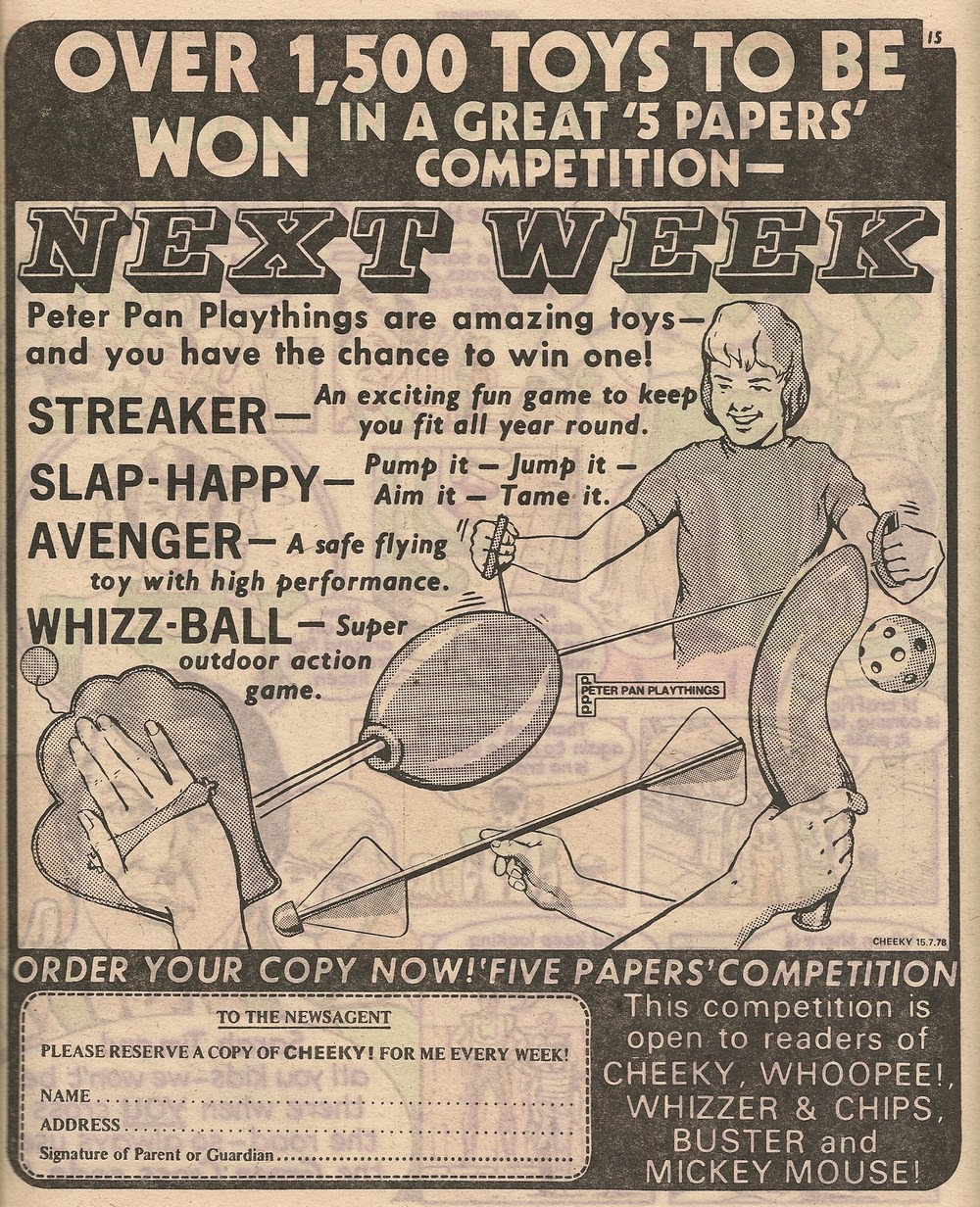
read the announcement of the 5 Papers Competition in Cheeky Weekly
dated 15 July 1978.
Later in the same issue
was another schedule of upcoming mini comics, once again introduced
by the toothy funster.
By the 26 August 1978
issue Buster had resumed its standoffish attitude and was absent from the titles participating in the forthcoming toy competitions
and simultaneous cut-out-and-keep promotion.
A variation on the same ad, featuring a reversed masked hero, appeared 7 days later. In addition to publicising the commencement of the cut-out games, the ad reminded readers that Whoopee was that
week running the first of the four toy competitions. Lone
Ranger toys were on offer, but the TV Western boom of the 50s and 60s was long-forgotten by this time, so the decision to market a range of action figures based on the masked man and his Native American pal at this particular juncture is a bit puzzling.
Whizzer and Chips was
the location of the toy competition the following week. The lucky
winners of the 10 star prizes would each receive a Clash of the
Robots game.
Art: Sid Burgon
It seems there was a
space that needed filling in Cheeky Weekly 7 days later as an ad
promoting our grinning pal's comic together with Whizzer and Chips and Whoopee
(oddly Mickey Mouse, the location of that week's toy competition,
wasn't mentioned) found itself squeezed into page 31 alongside the
concluding element of Saturday, the instructions for the Crack-A-Joke
Game and a stamp-collecting ad (please tell your parents).
IPC were at this time
clearly convinced of the effectiveness of the cut-out-and-keep
marketing ploy, as little time seemed to elapse without readers being
encouraged to cannibalise their reading matter. Thus it's little
surprise to find that as 1979 dawned another multi-comic ad turned up
in Cheeky Weekly (dated 06 January), heralding further upcoming
scissor-paste-and-cardboard action in the big 3 humour titles. Buster
yet again exempts itself, as does Mickey Mouse.
As we've come to
expect, the message was reinforced 7 days later to coincide with the
commencement of the promotions.
Friends of Cheeky who
were so inclined would have been sharpening their scissors on
learning, in the comic dated 31 March 1979, that '3 Super Pull-Outs'
with a 'pop' theme were due to commence the following week, one in
each of the usual 3 titles. Sweeny Toddler and the Bumpkin kids are
again on hand.to assist with the publicity drive.
The usual rehash of the
initial ad appeared the following issue....
...and a somewhat more
radical refashioning, in which the Sweeny/Bumpkin collaboration was replaced with a generic popster who looks to me to have sprung from the pen of Arthur Martin, was printed in the following edition...
Buster (which had absorbed Monster Fun since it last participated in a multi-title promotion) made a surprise reappearance (along with Mickey Mouse) in the
multi-comic ad in Cheeky Weekly dated 21 April 1979, announcing that
sachets of milkshake would be given free in each of the featured
titles over coming weeks. And - what a surprise - a cut-out feature
would commence in each drink-powder-bearing edition!
The follow-up ad in the
next edition was expanded to fill a whole page.
By 05 May 1979, the
milkshake boat had sailed as far as Buster was concerned so it's no
surprise that young master Capp's title is absent from another
full-page follow-up ad in which Sweeny and the junior Bumpkins have been replaced by two representatives of the target audience.
By the third week of
the Two Shakes promotion, the reinforcement ad was reduced to a half
page since there were only 3 comics still to provide thirsty comic
consumers with flavoured powder for their lactic libations. The same two readers' representatives were featured.
It's a little surprising
that IPC chose to launch a new humour/adventure comic at this time -
Jackpot – in competition with their own milkshake and cut-out
promotion running across more established titles.
The next 'multi-comic'
ad didn't strictly relate to comics – as Christmas 1979 drew
thrillingly close, many Cheeky Weekly readers will no doubt have left
their favourite reading material conspicuously open at page 8 of the
15 December comic, in the hope of finding one or more of IPC's humour
annuals under the tree on the 25th.
Page 27 of the same
issue carried news of yet another imminent competition running across
the familiar 5 humour titles (Jackpot is absent).
This was to be the last
multi-comic ad in Cheeky Weekly which, despite participating in all the
cross-comic promotions detailed above, evidently failed to establish satisfactory circulation figures and came to an end just a few
weeks later with the issue cover-dated 02 February 1980.
Palitoy's
multi-jointed marvel Action Man first appeared in UK toy shops in
1966, the year in which my age advanced into double figures. I
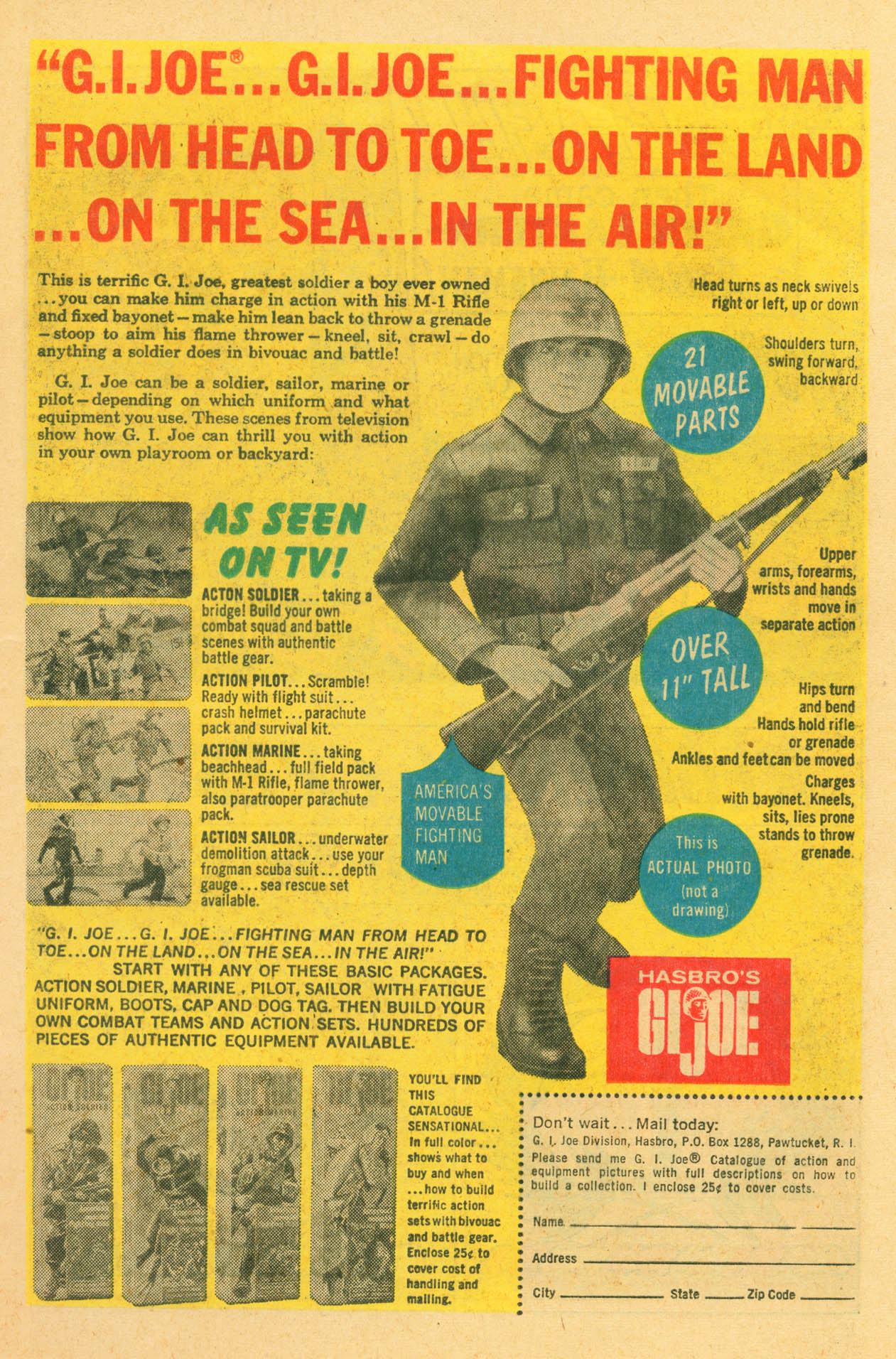
remember seeing tantalising ads for GI Joe (the original US version of
the same toy) in American comics some time before AM became available
over here. Thus I had been fantasising about staging my own miniature
military manoeuvres for several months by the time Action Man's
arrival on these shores was announced during an ad break on teatime
TV. Much parent-pestering ensued until I secured my very own small-scale scar-faced soldier.
The Action Man
figures came in soldier, sailor and airman varieties but although the
toy's name was changed for UK release, the basic uniforms supplied
with the models had a distinctly US appearance. However, a large
range of additional costumes and equipment was available in order to
expand the fighting figure's area of operations from snowy mountains
to outer space. I remember sending my AM on several reconnaissance missions to the depths of the bath after having provided him with appropriate clothing in the form of the scuba outfit. The snug-fitting
rubbery costume was very hard to get on and off the figure, and on
one occasion while removing his scuba trousers, I was horrified to
find that the bottom half of AM's leg had remained within the garment, having parted company with the rest
of his body. Fortunately this life-changing injury was short-lived as it was
possible to restore his lower limb by means of a plastic connector
protruding from the exposed knee joint (not the only way in which AM's anatomy diverged from that of a real-life, healthy male specimen).
As if the
possibilities for new adventures offered by the additional gear on
sale wasn't incentive enough, each pack of accessories came with
stars which could be cut out and stuck on a card. A card filled with 21 stars entitled the owner to claim a free Action Man, who arrived
completely naked except for a pair of boots. I did manage to get a
second Action Man in this way, and it was of course identical in every
way to the first (even down to the scarred cheek) except that the
new arrival's plastic hair was blonde in contrast to the original's
brown pvc locks.
By the time of Cheeky Weekly's first Action Man advert in the 30 June 1979 issue, my Action Men had long since been retired after distinguished military careers often taking them far beyond the call of duty, and the toy had evolved somewhat from the rather basic original. Later models were endowed with malleable, gripping hands rather than the inflexible digits of the versions I had, fuzzy hair instead of the plastic moulded coiffure of the mid-60s, moving eyes and even a voice-box. For all I know, the legs may have even been more securely attached. The Cheeky Weekly ad heralded a competition in which the first prize was a trip to the Blackpool Illuminations and a meeting with Action Man himself. Not only that, but a trip to the seafront Action Man Tableau (i.e. advertisement), a ride in the Action Man car and a princely £10 to blow on Blackpool Pleasure Beach were on offer.
Cheeky Weekly 30 June 1979
A clever element had been incorporated into the competition - the chance to win 200 Action Man stars (hence the competition name and the five-pointed designs exploding from the page). This mind-boggling booty would, if the late 70s Action Man star exchange rate was unchanged from the mid 60s, entitle the lucky winners to each accumulate a private army of 9 naked Action Men. However, the action figures themselves may not have been on offer as, crucially for Palitoy's sales, this aspect of the competition required entrants to study a list of eligible AM products listed on the entry form. Thus those who failed to get a prize but had been salivating over their gear of choice would no doubt add a few items to their birthday/Christmas present lists.
This ad was placed in a late June issue of Cheeky Weekly in order that the winner could be chosen in time for that year's Illuminations which ran for the traditional 66 days from switch-on (by Kermit the Frog) on 31 August.
As Christmas 1979 approached another Action Man ad appeared, this time focusing on the Transport Command line of vehicles designed to accommodate the fighting mini-man. Obviously conscious of opportunist toy manufacturers churning out cut-price AM-scale military machinery, Palitoy were keen to remind readers to look for the picture of Action Man on their packaging. Among the toys being promoted was the Sea Wolf one-man sub, which no doubt enabled the fighting figure to explore the depths of the bath in comfort and without risk of trouser-removal trauma.
Compared to IPC's long-lived Buster, Cheeky Weekly was a mere blip in the annals of comic history. Whereas the toothy funster's own comic managed a (by comparison) paltry 117 issues before expiring, Buster first appeared in newsagents in May 1960 and was published for almost 40 years, existing just long enough to stagger across the threshold of the new millennium as the last surviving IPC funny paper. Named after its cloth-capped cover star (introduced as being the son of Reg Smythe's Andy Capp, although direct references to this fact in the comic were limited to a few early issues), Buster over its long history absorbed many lesser IPC titles as their readerships dwindled to unsustainable levels.
Cheeky Weekly's 18 February 1978 issue was the first to feature an ad for Buster (which at that time still carried the title of its most recent acquisition as of November 1976, Monster Fun). This ad alerted prospective readers to a promotion in the following week's issue in conjunction with the manufacturers of Corona soft drinks. Corona themselves were concurrently running a series of animated TV ads featuring the punning strapline 'Every Bubble's passed its Fizzical', and the free stickers on offer to Buster readers in the upcoming issue tied into Corona's marketing campaign.
Seeking to retain any surge in Buster's readership resulting from kids who weren't normally readers buying the comic just to get their hands on the free stickers, the same Buster issue would include the first part of yet another of IPC's interminable line of cut-out-and-collect games. Enthusiasts wishing to complete a set of Match 'Em cards, and crucially obtain the all-important instructions, were obligated to buy the comic for the next 4 weeks. A pic of the titular character is featured in the ad, rather crudely pasted in. Why is he holding a pencil?
A variation on the same ad appeared in Cheeky Weekly dated 25 February 1978, reminding readers of the toothy funster's comic that the stickers and Match 'Em game were in that week's Buster & MF. The cut-and-paste Buster, his pencil now cropped, returns in the ad.
Cheeky Weekly's next encounter with a Buster ad came in the 04 March 1978 comic, by which time Buster was halfway through its cut out game. This ad would therefore have had little appeal to readers who missed the first part of the game, and indeed the text is clearly aimed at encouraging those who saved part 1 to continue to the end (and, the publishers no doubt hoped, beyond). Some examples of the cards are shown, featuring faces of Buster & MF stalwarts Plunk, Big Brother (from the Big Brother is Watching You strip), Kid Kong, and Tony Broke (from Ivor Lott and Tony Broke). I can't identify the character whose face appears in the third box from the left in the top row. The torsos and legs on display were mixed up to demonstrate the fun to be had with the game. Young Master Capp is missing from the ad entirely.
With admirable/irritating persistence, IPC inserted another ad highlighting the Match 'Em promotion in the following Cheeky Weekly, reminding readers that the third part of the game was in that week's copy of Buster. A further 6 cards were shown, this time featuring Faceache, then there's a character who I suspect is supposed to be Little Brother from the Big Brother… strip, followed by The Leopard from Lime Street (Billy Farmer's feline alter-ego), Ray (of X-Ray Specs), The Ghostly Leg (surely the most bizarre strip of the entire Fleetway/IPC line) and Kid (of Kid Gloves). All the characters seem to have been paired with their correct legs (or leg in the case of the spectral lower limb). Buster himself is again absent.
IPC clearly saw the Match 'Em promotion as a high-profile affair, because Cheeky Weekly dated 18 March 1978 carried an ad for it in the fifth consecutive issue. Admittedly the cut-out game, which was by then in its final week, gets a smaller mention as, under the banner 'Buster Rules OK' (a reference to the inclusion of the Match 'Em rules this week), the ad concentrates on selling the strips and features which appear each week. Buster is present in the ad, which is dominated by a large pic of false-teeth wearing shark, Gums.
There followed a break from Buster ads, until Cheeky Weekly dated 03 June 1978 carried a plug for the Buster Holiday Fun Special. A pasted-in Buster and the Special's cover shared the ad with some text detailing the fun and thrills to be had in return for 30p. Although the weekly Buster still carried the Monster Fun title on its cover at this time, the Holiday Fun Special makes no mention of the other comic. The same ad appeared in the following 2 issues of Cheeky Weekly.
One might have expected there to be an advertisement as Christmas approached for the 1979 Buster Book, which was published in autumn 1978, but none appeared. While most IPC comics had hardback versions published in the run-up to the festive period, for many years Buster's annual Christmas offering had soft cardboard covers, and all were called Buster Book rather than Buster Annual.
Unlike the previous year's Buster Holiday Fun Special, 1979's Buster and Monster Fun Spring Special, which was advertised in Cheeky Weekly dated 14 April 1979, not only mentioned the title of the 'absorbee', but gave it greater emphasis than the host comic. I've never seen a copy of this special, so I can't comment on what might have made it, according to the blurb, 'unusual'. Probably it featured predominantly Monster Fun characters - the ad text and pics of Kid Kong and the skeleton from Terror TV suggest this may have been the case. As we have come to expect, a pasted-in Buster was also on display in this ad. A different image of Tin Teacher has been overlaid on the special's cover - the actual cover can be seen among the specials here. There was a 10p price hike since the previous year. The same ad returned in the following 2 issues of Cheeky Weekly.
My assumption about the Monster Fun bias of the aforementioned special would seem to be confirmed by the ad for Buster Holiday Special in the 02 June 1979 issue of Cheeky Weekly. There's no mention of Monster Fun on its cover, although MF's Kid Kong shared the front page with Buster, and another survivor from MF, Gums, was included in the ad, utilising the same image that appeared in the ad dated 18 March 1978. Like the advert for the Buster and Monster Fun Spring Special, this ad appeared in 3 consecutive issues of Cheeky Weekly.
The 1980 Buster Book was first advertised in Cheeky Weekly dated 06 October 1979. Under the strapline 'Take off with Buster!' (a reference to the events depicted on the Book's cover) a pasted image of Capp junior on roller skates has been used as presumably the staff member compiling the ad was unable to locate another image of Buster on skis. The ad also ran in Cheeky Weekly the following week.
Cheeky Weekly's brief existence on the newsagents' shelves spanned 3 Christmases; those of 1977, 1978 and 1979. Sadly, however, industrial action prevented publication of the Christmas 1978 issue, although much of the work prepared for that issue eventually surfaced in one form or another.
Thus, there were only ever 2 in-house ads promoting forthcoming Cheeky Christmas fun. The first appeared on page 30 of Cheeky Weekly dated 24 December 1977 (the full-blown Christmas issue appeared a week later, cover dated 31 December 1977 and with an official on-sale date of 22 December).
The artwork for this half-page ad is dominated by a drawing that was utilised a number of times in the comic, and is what I refer to as the 'standard Cheeky face' (as seen at the top of this blog). The toothy funster invites readers to spend Christmas with him and his 'pals' (a rather quaint, archaic word which by the late 70s' was only ever used in comics).
Below our hero's grinning mug, and surrounded by a holly border, a random cast of Cheeky Weekly characters have been assembled by some deft cut-and-paste action. To enhance the seasonal effect, certain of Cheeky's co-stars are sporting pencilled-in festive headgear. Snail bravely risks a sarky remark about Ursula.
Among the milling throng were 2 characters who actually didn't appear in the following week's comic, Doodle Doug and Milkie. The less-than-seasonal evil leer that Doug is displaying here is a possible reason for his exclusion from the festive issue.
Two years later, and sharing the page with an ad for the 1980 Cheeky Annual, this half-pager appeared in Cheeky Weekly dated 22 December 1979;
No doubt due to budgetary constraints, the cast list for this ad is pared down to Cheeky and Snail, and no festive border is present. The toothy funster models a rakish topper-and-scarf combination, as Snail hitches a ride. Us 'pals' are exhorted not to miss the seasonal issue, and Snail is on-message with his advice to order a copy. Prospective purchasers are promised a comic 'full of festive fun'.
Paul from the excellent Cobwebbed Room blog has enquired about this ad which appeared in Cheeky Weekly dated 08 July 1978, so I thought I'd post it rather than describe it - you're welcome to use it on your blog, Paul, if it's one that you haven't already featured.
A rather staid presence on British high streets for many years, WH Smith, retailer of books, magazines, stationery, toys and comics, placed 11 advertisements in Cheeky Weekly.
The first ad appeared in the comic dated 15 April 1978. This debut ad was part of a marketing campaign capitalising on two current crazes; skateboarding and Star Wars. It seems that the mere mention of Star Wars was considered enough to get kids hurtling through the doors of their local WHS, as the ad doesn't specify what the Luke Skywalker-related product actually is. But whatever it is, it's only £1.50. Bargain!
The next two products to be mentioned in the ad are somewhat less exciting; Playpeople and Beetle. The latter conjures up images of dreary Sunday afternoons spent hunched over a box containing a selection of synthetic insect parts (at least one leg was always missing).
The ad then perks up with the news that shoppers at WHS have a chance to win a pony or adventure holiday by completing an entry form "with free naturescope to make" (roll the form up, point it at ant, look through it).
Note that the raging inflation which stalked late 70s high streets necessitated the disclaimer 'Prices correct at time of going to press'.
The next WHS ad to appear coincided with the start of the school summer holidays, and graced the pages of Cheeky Weekly dated 05 August 1978. This time, the promotion was based on Corgi, Matchbox and Dinky model vehicles so, unlike the previous ad which attempted to attract both genders, this was firmly aimed at young males. The prizes on offer in the Super 6 Competition consisted of macho activities of various descriptions. And there's 4p off a Matchbox Blaze Buster (Prices are still only correct at time of going to press, so by the time you get to your local store, the Blaze Buster could have gone up 10p).
Surprisingly, Smiths apparently declined to place an ad in the run-up to Christmas 1978, and their next promotion appeared in the comic dated 07 April 1979, almost a year after their initial ad. The Outdoor Quiz campaign is clearly female-oriented, as the main prize is a pony (maybe nobody won the pony in the previous competition). Hopefully some sort of stabling and maintenance is also provided - no doubt all that was explained on the entry form. There is an alternative prize of a sailing holiday, but most boys would have stopped reading the ad as soon as they saw the Win A Pony headline. No prices are mentioned in the ad so there's no need for the 'correct at press time' disclaimer. This ad appears on page 22 unlike the two earlier ads which both occupied page 14.
Entries for The Outdoor Quiz can be made up to 18 May 1979, but on 21 April 1979 another Smiths ad appeared, again on page 22. This time, the focus is on books. Smiths can't quite rid themselves of a whiff of nostalgia, as the first book advertised is an Enid Blyton title. The quintessentially British children's writer had died in 1968, but presumably her books were still selling well as the 70s drew to their turbulent conclusion.
It seems that Cheeky Weekly's 6 Million Dollar Gran is not the only attempt to cash in on the success of TV's Six Million Dollar Man, as joke book The 6 Million Dollar Cucumber is among the titles mentioned in the ad. A couple of comic-type publications are also plugged; the potion-swilling Gaul returns in Asterix and Caesar's Gift, which appeared in English translation in 1977, and TV's frog-and-pig duo feature in the newly-published Muppet Comic Book. The scifi boom launched by Star Wars is evidently still thrusting through the stratosphere - the first book in Terrance Dicks' Star Quest trilogy is also given a plug.
As ever, prices were correct at the time of going to press - by the time you get to the shops, who knows?
Page 5 is the home of the WHS ad in Cheeky Weekly dated 28 April 1979, in which the Outdoor Quiz is given another push. This time it's made clear that free stabling is provided for the lucky winner of the pony, and the ad takes a more mixed-gender approach than that which appeared 3 weeks earlier. Fungus The Bogeyman and Battlestar Galactica books get plugged. Prices correct at…you know the rest. Take a couple of extra quid with you just in case.
A rather bold idea appears in the 19 May 1979 comic - an ad which doesn't feature the name of the advertiser, or at least not until the reader has applied pen to paper.
The period of intense WHS advertising continues in the 30 June 1979 issue as, just in time for the start of the '79 summer holidays, a number of items essential for any kid's hols are given a push. Inflation remains high - the disclaimer is still appearing.
All credit to the WHS marketing department - they're certainly running plenty of promotions. Next up, in the 04 August 1979 comic, is an ad informing us that a new Dinky, Matchbox and Corgi promotion will furnish free posters to purchasers of toys from their ranges. The same ad appears in the following week's issue.
With the nights beginning to draw in, and the end of the school holidays looming, the next WHS ad, in Cheeky Weekly dated 01 September 1979, directs our thoughts towards indoor pursuits with which to while away the gloomy months ahead. This time the retailer is running a promotion in conjunction with board game manufacturer, Spears Games. 50 Scrabble games are to be won. The disclaimer returns, and a rather odd selection of prices is on display, with no two games selling for the same amount.
The final WHS ad to appear in the toothy funster's comic was to be found in the 29 September 1979 issue, and focused on that much-anticipated British comic institution, the Annual. Books from a variety of publishers are featured. Was this the only occasion on which DC Thomson's notorious school gang The Bash Street Kids from The Beano appeared in an IPC comic?